%20-%20Google%20Store%20.png)
Aero Position Fundamentals: Where to Start in 2026
- Martin Ulloa
- 5 hours ago
- 7 min read
The science behind why position always comes before equipment — and what that means for your season ahead.
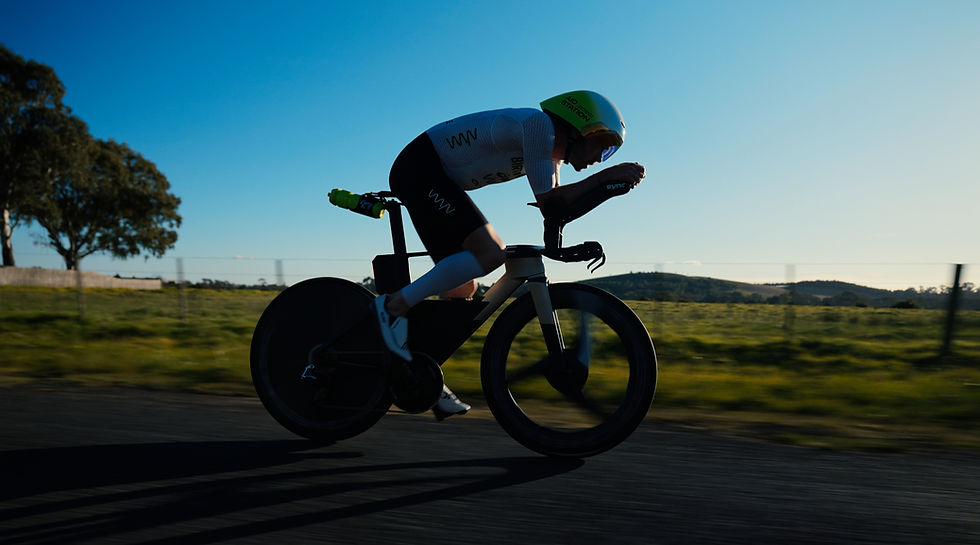
Every year, as the race season opens, the same question surfaces across age groups and professional triathlon alike: what do I need to go faster on the bike?
The instinct is usually to look at equipment. A new wheel set. A different helmet. A lighter frame. And while those things matter — and we'll be talking about all of them this year — none of them will unlock the performance you're looking for if the foundation isn't right. That foundation is your position.
At Sync Ergonomics, we've spent years working with athletes at every level, from first-timers on clip-on aerobars to WorldTour time trial specialists, and the principle is always the same: position first, equipment second. Here's why that's not just a philosophy — it's physics.
The biggest variable on your bike isn't your components
When you're riding at triathlon race pace — typically around 45 km/h for competitive athletes — aerodynamic drag accounts for roughly 90% of the total resistance you're working against. Of that, about 30% of your aero drag can be attributed to the bike and 70% can be attributed to airflow over your body. What this means in practical terms is that the shape you make with your body on the bike is, by a significant margin, the largest performance variable you can control.
A poorly optimised position can cost an athlete three, five or even double-digit minutes over an IRONMAN bike leg compared to a well-fitted one — even on an expensive, aero-optimised machine. Put another way: a rider in a genuinely good position on a mid-range TT bike will consistently outride a rider in a compromised position on a top-of-the-line setup.
This isn't a knock on equipment. It's a reminder of where the leverage actually is.
What "optimised position" actually means
Position optimisation is not about getting as low as possible. That's one of the most persistent misconceptions in the sport, and it costs athletes watts, comfort, and often their run.
A truly optimised aero position balances three things simultaneously:
Aerodynamic efficiency — reducing your frontal area and CdA (coefficient of aerodynamic drag) without creating unnecessary turbulence or an unstable profile at yaw angles you'll actually encounter on course.
Power output — maintaining enough hip mobility and a sustainable torso angle so that your ability to generate and sustain power across the bike leg isn't compromised. An athlete who is "perfectly aero" but can only hold the position for 40 minutes has lost the game before T2.
Transition to run — the position you hold for 90km or 180km shapes how your body arrives at the run. Excessive compression through the hip, or positions that create posterior chain fatigue, will express themselves on the run course, whether you feel it on the bike or not.

This is why the high-hands approach — the design principle underpinning Sync's Aerobar Three (AB03) — isn't just an aesthetic choice or a trend. It emerged from our experience in aero testing, that elevating hand position relative to elbow position allows athletes to achieve a narrower, more aerodynamic frontal profile without the hip compression that comes from simply slamming stack height. You get the aerodynamic benefit without the biomechanical cost.
IRONMAN vs the 40km ITT: same position, different demands
Non-drafting triathlon and the individual time trial are the two disciplines where position optimisation matters most — but they're not the same challenge, and treating them as identical is a mistake that costs athletes performance in both directions.

The 40km ITT is a maximal effort. You're on the bike for somewhere between 40 and 60 minutes at the elite level, and the singular objective is to sustain the highest possible power output in the lowest possible CdA for that window. Because the effort is short and intense, athletes can tolerate more aggressive positions — greater torso compression, lower stack, more forward weight distribution — without the same physiological consequences that would accumulate over a longer effort.
What complicates things further is that UCI regulations impose strict geometric limits on how a rider can be positioned on a time-trial bike. Those limits are tied directly to the athlete's height. The rules govern the relationship between the bottom bracket, the saddle setback, and the maximum reach and stack of the front end — meaning a taller rider operates within a materially different positional window than a shorter one, even on identical equipment.
A 190cm rider and a 165cm rider aren't just dealing with different bike sizes; they're working within different regulatory boundaries that shape what an optimised position can actually look like. Within those constraints, the ITT rewards positions that are aerodynamically optimal, even if they're only truly sustainable for under an hour.

IRONMAN is an entirely different equation. The bike leg alone runs between 4.5 and 5.5 hours for competitive age groupers, and it's followed by a marathon. The position you hold at kilometre 10 needs to still be functional at kilometre 170 — and it needs to leave your legs and hips in a state where running 42 kilometres is a realistic proposition. This changes what "optimised" means fundamentally.
What works on a 40km TT course will often fail an athlete across a full IRONMAN. The compressed hip angles that feel powerful for an hour become a source of fatigue and muscular shutdown over four or five. The aggressive forward weight distribution that maximises aero efficiency in a short effort creates cumulative load through the arms and shoulders that compounds badly across a long day. And positions that don't account for the run — that prioritise pure bike speed at the expense of how the body exits T2 — tend to reveal themselves painfully around kilometre 10 of the marathon (or sooner)
But where you land on each of those trade-offs shifts meaningfully depending on what's coming after the finish line. This is one of the reasons position work done specifically for the distance and format you're racing matters so much. A position built for a 40km TT and then taken directly into a full-distance triathlon is a common starting point — but it's rarely the finishing point for athletes who take their performance seriously.
The saddle conversation nobody has early enough
If the front end of your bike is where position optimisation starts, the saddle is where it either succeeds or falls apart — and it's the piece of the puzzle that gets left until last far too often.
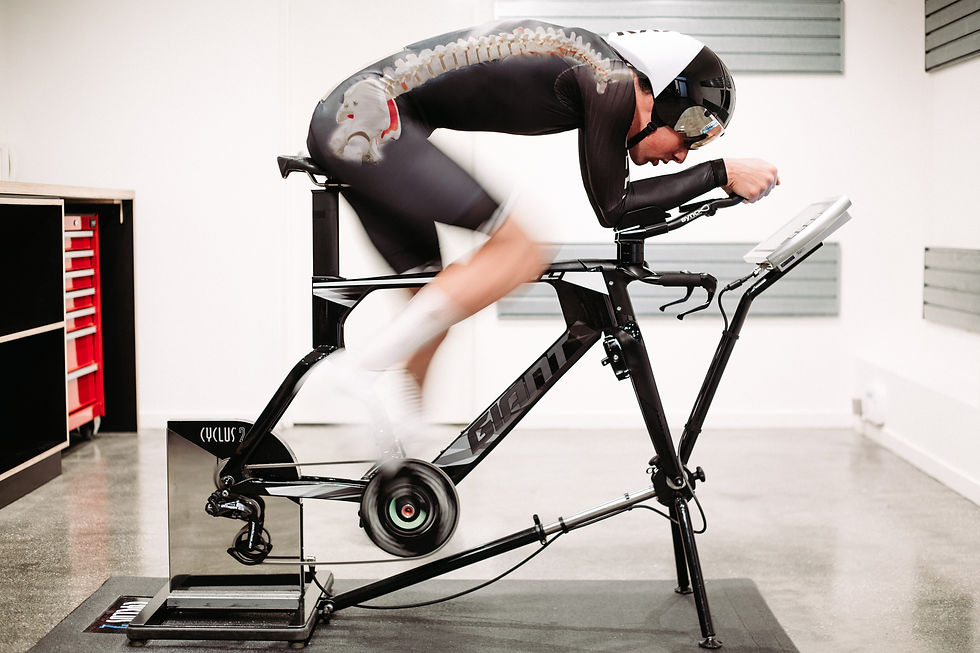
In a TT or triathlon position, your pelvis rotates forward significantly compared to a road riding position. That pelvic tilt changes everything about how you interface with the saddle: your sit bones are no longer the primary contact point, soft tissue pressure increases, and a conventional road saddle — regardless of how comfortable it is for road riding — becomes a liability.
One of the clearest signs that an athlete is on the wrong saddle is excessive nose tilt. You can see this bright as day in a very popular $500 saddle that is being used by some triathletes.
If you find yourself dropping the nose of your saddle significantly just to manage pressure or discomfort, that's worth paying attention to — because what it usually means is that the saddle geometry isn't suited to a forward-rotated pelvis in the first place. Tilting the nose down is a workaround, not a solution, and it introduces its own problems: it shifts your weight forward onto the front end, increases load through the arms and shoulders, and makes it harder to hold a stable, efficient position over time. If you need an excessive tilt to make a saddle tolerable, the saddle is the issue — not your fit.

This is something we feel strongly about, and we'll say it plainly: in our experience working with athletes across the full spectrum of the sport, the saddles genuinely designed for the demands of a proper TT position are a very short list. The ones that consistently come up, for good reason, are ISM and Dash.
Both brands built their designs around the specific biomechanical reality of a forward-rotated pelvis — the cut-out geometry, the nose profiles, the pressure distribution — in a way that most saddles simply don't address.
That's not to say no other saddle can work for any individual, but when we're starting from scratch with an athlete, those are the two we keep coming back to, race after race, athlete after athlete.
Getting the saddle right isn't just a comfort issue. It directly affects how much of your power you can actually transfer, how long you can sustain the position, and crucially — how your hips and legs feel when you rack the bike and start running.

Where to start if you haven't had a bike fit
If you're heading into 2026 without a current, data-informed position on your TT or triathlon bike, that's the first thing worth addressing before you think about any equipment upgrade.
A good bike fit — one built around your individual anthropometry, flexibility, and the demands of the specific distances you're racing — will give you a reference point for everything else. Saddle height, fore-aft position, stack, reach, elbow pad width, extension angle: each of these variables interacts with the others, and changing one without understanding the system leads to the kind of piecemeal tinkering that rarely produces meaningful results.
If you're already riding a position that feels comfortable and sustainable, the next question is whether it's been validated against actual aerodynamic data.
Comfort is necessary but not sufficient. A CdA measurement — whether from a wind tunnel session, a field test, or a track day with the right equipment — gives you the objective anchor that subjective feel alone can't provide.

The season starts with the right questions
As the 2026 race calendar gets underway, the athletes who will extract the most from their equipment and their training are the ones who've asked the right questions first. Not what should I buy? But where am I losing time, and why?
More often than not, the answer lives in the position. Start there, and everything else gets easier to optimise.
At Sync Ergonomics, our singular focus is improving the human-bike interaction. If you have questions about position optimisation, aerobar setup, or whether the Aerobar Three is the right fit for your position, get in touch — we're always happy to talk through it. Please reach out at sales@syncergonomics.com if you have any questions


Comments